G'day! I'm Chris. I left my home in rural Australia back in 2007 to pursue a life less ordinary.
I specialize in ambitious travel - bucket list worthy journeys such as the Great US Road Trip, the ultimate African safari, and following the length of the Silk Road.
While it’s been some time since I could be called young, you may notice that my bucket list expresses my desire to one day get my driving license. So while this collaboration post is aimed at young drivers, it seems relevant to me with my total of maybe an hour behind the wheel.
The Best US Road Trips for Young (or inexperienced) Drivers
If a young driver is looking for inspiration to help pass their test, then they should look no further than the ‘road trip’. This can be a once-in-a-lifetime adventure with friends or family taps into a young person’s spirit of adventure and helps them explore and enjoy new places and open their horizons in a flexible and fun way. The open road beckons and there are some great ideas for young drivers to enjoy when it comes to road trips.
Younger drivers should aim to find places that broaden the horizons and also feature plenty of places to stop off – bearing in mind that a novice behind the wheel shouldn’t look to give themselves too much to do right away.
Here a few to whet your appetite…
Pacific Coast Highway, California
The Pacific Coast Highway in California, also known as PCH, is a 10-hour drive that will take you from the border of California in Oregon to San Diego. This is a good location for a road trip as a leisurely drive allows you to take in the breathtaking and varied views including forests, seaside villages, and the coast.
I pensively pose atop the cliffs of Big Sur. Such a beautiful drive.
With more than 1,000 kilometers of driving, you are sure to have a road trip to remember. Of course, you can stop in different locations along the way including Santa Cruz, Monterey, Pismo Beach, Santa Barbara, Malibu, and Los Angeles – iconic stops that offer plenty to any traveller.
Blue Ridge Parkway
For an all-American adventure, go on a journey in North Carolina and Virginia via the Blue Ridge Parkway that spans 755 kilometers and goes through 29 counties in North Carolina and Virginia. The parkway is popular for its scenic route and is considered the longest linear park in America. While driving, you can pass by different locations including the Biltmore Estate in North Carolina and the Blue Ridge Music Center, if you’re into music.
Olympic Peninsula, Washington
Are you in for a loop? Then the Olympic Peninsula in Washington may just be the best driving experience for you if you want to have a road trip with your friends and family. While driving, you are in for a treat with views of wonderful waterfalls and stunning shorelines that can be found in Washington. You can also get some pictures of the Olympic Mountains that have peaks covered in snow. Photo opportunities like this are essential for the perfect road trip.
Columbia River Highway, Oregon
Another scenic route that is great for road trips is the Historic Columbia River Highway in Oregon. The highway spans 121 kilometers, and it is known as the very first planned scenic road in the U.S. Building of the highway began in 1913, and now it is known as a National Historic Landmark where you can have majestic views of river gorges and waterfalls. This is the perfect road trip location for those who want to experience the beauty that Mother Nature has to offer.
The stunning Multnomah Falls are undoubtedly a highlight of the drive.
You’ll be wanting to see off on these amazing road trips as soon as possible and that means passing your test, and passing it as quickly as possible. There are plenty of resources online to make learning the rules of the road quicker, cheaper and easier than ever so start there and then concentrate on honing your practical skills behind the wheel. The combination of the two will help set you on your way to an amazing road trip adventure.
Your Say
What is your favourite road trip in your own back yard?
Jingshan Park is a vast island of green at the heart of China’s capital – a network of paths that weave in and out of secluded groves, twisted rock sculptures, and water features.
Perhaps best known for its hilltop pagoda and the stunning view it affords of the Forbidden City’s impressive rear, Jingshan was intended only as a place we had to pass through on our way to Beijing’s most famous landmark.
Jingshan Park’s hilltop pagoda offers a unique view of the Forbidden City.
At first it felt like every other Chinese park my travels had taken me through. The twisted willows and the regal poplar were beautiful, but nothing I hadn’t seen on the shores of Hangshou’s West Lake or Nanjing’s Xuanwu Lake.
“I would kill to lie in that grass,” I inform Corinne as we make our way into the park. It’s been another criminally hot day in Beijing, and our morning has been spent climbing up and down the stairs in the Bell & Drum Towers.
I’m onto my fourth or fifth bottle of water for the day, and the idea of stretching out on deliciously green grass is right up there with getting to third base with Scarlett Johannsen on my wish list right about now.
The Bell Tower (pictured) and Drum Tower are local icons worth a visit.
My mind is already on post Forbidden City Beijing duck and beers and I’m perhaps guilty of not immediately appreciating how picturesque Jingshan is. For all of their aptitude at building vast concrete jungles in record time, the Chinese are also masters of creating beautiful parklands at the heart of even the most rapidly developing industrial city.
A Chinese park is far more than simply a place to throw around a football or have a picnic lunch. Centuries of tradition have made the creation of parks an art form. That’s not hyperbole either. Chinese parks are works of art in their own right. The pagodas, the ponds, the gardens, the trees, and even the hills are woven together in a living tapestry that expresses some aspect of Chinese culture that we as visitors are perhaps only able to appreciate on a surface level.
Perhaps my past experiences in other parks have dulled my senses somewhat.
“This is nice,” I observe aloud, but my appreciation doesn’t immediately go beyond that.
Houhai Lake, near Jingshan Park, is also a pleasant escape from the hustle & bustle.
It’s as we’ve rounded a corner and are walking ‘neath the shade that exists between a line of trees and a high, rocky outcrop that we hear the first strains of singing.
We find the singers – a group of elderly Chinese gentlemen clustered around a bench upon which an accordion player sites – and are momentarily struck dumb. The seven or eight men sing operatically in perfect harmony, passing around a single sheet of lyrics to any newcomer who wishes to join.
One of many groups of old people belting out tunes in Jingshan Park.
As if their music opens our ears further to the noises of the park, we’re soon drawn to an even louder choir. At the foot of the hill leading up to the park’s famed pagoda, we come across a horde of locals. Men and women alike stand in a messy circle around a single conductor and together they belt out tunes from a different time.
The men and women harmonise at times and at other times sing separate refrains. The spectacle is utterly enchanting. It’s all I can do to fumble my phone out of my pocket and try to capture the moment as best I can, and I know Corinne is similarly astounded by the display.
The sheer beauty of their singing is enough to move both of us to the verge of tears. The strength of community that must exist to draw these people together in their shared love of the songs they sing and the country they sing for is something alien to somebody from emotionally distant Australia.
It’s how I imagine church must feel to those who don’t yawn their way through sermons.
It was during that entirely unexpected serenity that a second thought dawn upon me and conjured up a different kind of tears.
Listening to these elderly people sing the songs of a time before China opened its doors to the western world, I was reminded of a very sobering fact:
This very beautiful display dies with them.
The children of modern China are more concerned with Game of Thrones, DoTA, and the Kobe versus LeBron debate to have even learned these proud songs of Chinese imperialism. The only songs I ever heard my students singing were from whatever K-Pop idol had made the biggest splash of late.
My children, should I ever accidentally father some, won’t be able to hear this display. They can visit the same park and marvel at the same view, but there is a very finite amount of time left to see and hear the last generation from ‘old China’.
The world is getting smaller by the day, and these vestiges of a time when countries weren’t all quite as eager to be the same as one another are getting fewer and farther between.
The Great Wall of China, barring some disaster, will remain for generations of tourists to see.
But there’s a very small window of time left to experience Jingshan Park and hear the singing on a Sunday afternoon.
Knowing this, and realising just how lucky I am to have witnessed it, the tears came anew.
Jingshan Park, a place I hadn’t even thought of as a ‘must see’ when planning my Beijing trip, turned out to be one of the most affecting travel experiences I’ve ever had.
Your Say
Have you ever been completely surprised by a place you hadn’t expected much from?
I must start off with an apology. It’s been a ridiculous amount of time between posts, but I’ve got a good excuse. Both China and Namibia provided me with a wealth of stories, but not a wealth of free time. Between the patchy internet and the long days in search of adventure, it was a rare evening where I had the time or energy to do much more than Facebook.
Now that I’ve set myself up a semi-permanent base of operations here in Tanzania (more on that later), expect the stories and pictures to come thick and fast!
A Confession
I think we’re all guilty of letting our preconceived notions colour our decision making when we travel.
We hear or read negative things about a place and we decide in advance that it isn’t for us. Or, even worse, we simply assume that because hordes of tourists go to a place – we’re somehow above it.
Or maybe I’m guilty of a second generalisation. Maybe it’s just me who forms these opinions without basis.
Whatever the case, Beijing was a city I’d long made a point of avoiding despite its rich history and the presence of world famous sites such as the Great Wall of China and the Forbidden City.
Which isn’t to say the Great Wall isn’t pretty spectacular…
“It’s too polluted” I’d say as I justified it to myself, “It’s crowded and messy”.
Still, the most common follow-up question to me telling people I’d lived in China for two years was inevitably “Oh! What was the Great Wall like?”
It became a point of embarrassment that I had called the country home but not seen its most famous cultural site. Like being to the US without seeing the Statue of Liberty, or going to Australia and not taking in the majesty of the Opera House.
When I decided to revisit my old stomping grounds en route to Africa, I decided to bite the bullet and do Beijing.
And my first day there made me so glad I did.
As with most things judged in ignorance, I was way off base with my opinion of Beijing.
Exploring the Hutongs
With nineteen hours of travel still fresh in my system, I wasn’t feeling up to battling the crowds at the Forbidden City on my first day in Beijing.
Instead, accompanied by my ridiculously gorgeous and talented friend Corinne, I decided to set out on foot and take a leisurely day strolling through Beijing’s labyrinthine hutong district.
Hutongs are a network of alleyways and low cost houses in which the local people reside. If the Imperial sites represent China’s historic rich and the business district its present day wealthy, then the hutongs are the best representation of everyday Beijing life.
Friendly rickshaw drivers ride by, constantly offering to take the leg work out of your exploration.
Stepping off the busy streets of the city and into the quiet, shady hutongs is like stepping behind the scenes in a big budget movie. The people here aren’t wearing suits or carrying the latest Vera Wang bags, they’re kids running barefoot or men with their t-shirts hiked up to reveal their bellies and (I’m told) cool them off on hot summer days.
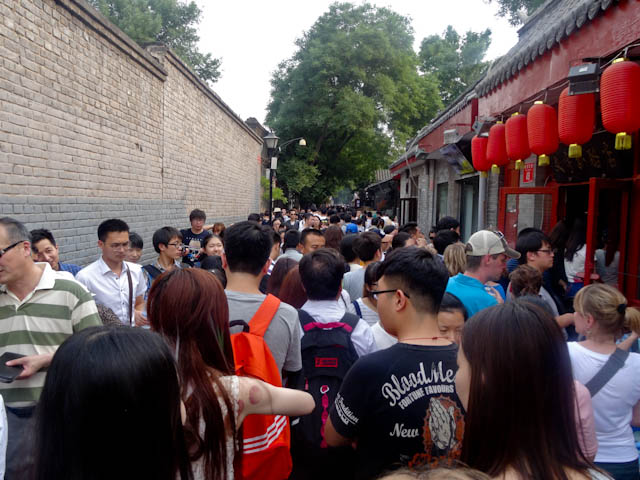
And hot it was. My first day in Beijing was greeted with 33C of bright, sunny Saturday. The heat lent the entire day a kind of carnival atmosphere – people drank beers or iced coffees in cute alleyway eateries, ducked into boutiques to browse and avail themselves of the air conditioning, or simply meandered about letting the flow of people and their own whims guide them.
Beyond the arteries of modern China’s multi-lane expressways, these narrow and often cluttered veins are a dizzying cacophony of chattering people, honking scooters, and music blared from store fronts.
Amid all of the noise and the jostling crowds, your nose is assaulted by the competing scents of perfumed boutiques, street vendors, and the authentic stink of an area well lived in.
The crowds out in force on a food street. Don’t worry, they thinned out pretty quickly.
Duck around a corner, though, and you’re suddenly on a street whose serenity seems completely incongruous. The wind rustles the leaves of the trees that shade our walk, and up ahead a local boy makes beautiful music completely apart from the hectic activities of the next street over.
I was surprised by just how green Beijing is. I had expected a built up concrete jungle.
Late at night, completely alone and bathed in the ever present gold of street lights, the silence is broken only by the distant sounds of traffic or the occasional cough from a sleeping resident. Despite the darkness and the menace of the unknown lurking in side streets, you feel perfectly safe. I got myself intentionally lost just so I could take it all in without the pretense of getting from A to B.
It might not sound enchanting, but it really is. Here the smiles are not forced and there are no airs and graces. You’re simply a part of the crowd going about their business, and there’s a fantastic authenticity to it all.
Let’s Talk Specifics
It’s certainly possible to take a guided tour through the hutongs. If you aren’t comfortable with navigating these maze like alleyways, services like Context Travel can lead you through it all – explaining the history of the various districts and guiding you to the most interesting corners.
I didn’t try their coffee, but their import beers selection was certainly ‘fucking good’.
For me, it was more fun to just let our feet take us wherever we fancied.
We ducked into the very groovy Plastered to browse their selection of counter-cultural t-shirts and oddities, and I picked myself up a completely over the top ‘Motherfucker in CBD’ t-shirt that needs to be seen to be believed.
We stopped off in hole in the wall bars with rooftop seating, quirky decorations, and bold claims that they possessed ‘The best fucking coffee’, chatted with locals, admired street art, and just soaked it all in.
An ice cold beer on a scorching hot day. Bliss.
They’re a far cry from the pomp and circumstance of the classic Imperial sites, but the hutongs offered up a much more candid, engaging view of modern China. So much is made of China’s emergence as an economic powerhouse, but it’s this kind of down to earth experience that lingers with me a fortnight after departing.
As we sipped an ice cold beer atop one of the countless rooftop bars that dot the district, we were offered a birds eye view of a population going about its business unconcerned by China’s reputation as a sleeping giant. Day to day life for these locals may seem humdrum to them, but to me it was a day of discovery that I’ll not soon forget.
More Specifically
We didn’t follow a tourist map or seek out specific spots while we wandered, so I can’t give you a step by step guide to recreating our journey. I wouldn’t want to.
What I liked most about the hutongs is that I could visit them again tomorrow and have a completely distinct experience.
Still, there were a few spots that I really liked.
Plastered T-Shirts did some great, off the wall shirts, jackets, and bags that I could have spent a fortune on. As it was, I limited myself to just the one.
How could I not go into a store with this bad-ass statue in the window?
As far as hutong bars go, you’re really spoiled for choice. They’re available in abundance, and have remarkably cheap local and import beers. We particularly like Siif Bar, with its promise of ‘the best fucking coffee’ and its well traveled manager.
But the hutongs aren’t about individual destinations. They’re about the journey: the sights, sounds, smells, and interactions that combine to create something unforgettable and unique.
Grab your hotel address, pack a little spending money, and let the current of the hutongs take you where it will. You won’t regret it.
Impressive fairy floss in the hutongs of Beijing.
Your Say
Have you ever formed a baseless opinion of a place before you visited it, only to be proven wrong?
Do you enjoy stepping off the tourist track and checking out how the locals live? What country or city has most surprised you in this regard?
If there’s one question I was tired of answering when talking to people about my time in China, it was “What was the Great Wall like?”
In my two and a half years of calling China home, I visited some pretty remarkable places. I spent entirely too much time in Shanghai, I paid a visit to beautiful Jiuzhaigou in Sichuan, I played cricket in Xiamen, and I explored the wild west that is Xinjiang province
But I never did make it to the Great Wall.
My first real look at the Great Wall took my breath away.
Redemption
When I decided I’d be paying a return visit to my former home over the university break, I decided to make visiting Beijing my first order of business.
It seemed somehow criminal that I hadn’t made it to China’s most famous city in all of my time calling the country home.
Much like my uneducated impression of London, I’d been guilty of deciding ahead of time that I wouldn’t like Beijing. I talk about this in more detail when describing my experience in Beijing’s hutongs, so I won’t go into details again here.
I was even guilty of deciding in my head that the Great Wall was somehow missable, like it was an icon in name only and wasn’t deserving of its fame.
How wrong I was.
Thanks to my friends at Great Wall Hiking, I was not only able to have my opinion proven wrong, but I was able to do so along one of the most picturesque, visually stunning sections of the wall.
Stunning.
Jinshanling to Simatai West
Located a three hour drive from Beijing proper, this largely unrestored section of wall offers up a more historic, authentic experience than crowded Badaling or touristic Mutianyu.
Far from the crowds of selfie-stick toting tourists and tour groups wearing matching baseball caps, the first impression upon arriving at Jinshanling is one of utter peace and quiet.
Our small group of four are all alone as we check in, lather ourselves in sunscreen (special thanks to Banana Boat for providing the sunscreen!), and prepare to head up to the mountain. The spacious visitor’s centre seems like a white elephant of the highest order as our footsteps echo in its vast emptiness.
Thanks to Banana Boat for protecting my dome on a hot and sunny day.The entire group (all four of us) posing in one of the guard towers. Photo by Great Wall Hiking.
“We will start walking up 1.7km of stairs to the wall,” our guide Peter informs us as we depart.
Peter, who hikes the wall something like twenty times a month, is not only ridiculously fit, but is also a font of knowledge on the wall. During our three hour drive he’d regaled us with an extensive history of the wall – from its origins to its construction to the three times in its history that it was breached.
His passion for the subject was infectious, and we were all bouncing on the soles of our feet with anticipation.
The Climb
Despite the best efforts of my personal trainer, I was woefully unprepared for just what an exhausting exercise it is to climb up 1.7km of stairs in the heat of the mid morning sun. I’d clearly underestimated just how difficult the hike was going to be, and slacked as a result. Stupid fatboy.
While the adorable American couple and the leggy Aussie ahead of me seemed to tackle the steps with aplomb, I paused frequently to ‘take photos’ as a cover for my burning need to suck in more air and shudder through the veritable torrent of sweat that was pouring from every perceivable orifice.
Stand back ladies, I’m gushing.
Climb as I might, the wall never seemed to get any closer.
On several occasions I’d glance up at the distant wall and curse it.
“Why the fuck aren’t you getting any closer?”
The wall gave no answer. It treated me with the same disdain which it met hordes of Mongolians with centuries before.
Bastard wall.
I was approaching the white light and speaking in tongues when all of a sudden one of the towers loomed over us, blessing us with the kiss of its shade and a reprieve from the walk.
I was exhausted and we hadn’t even set foot on the wall yet.
A blessedly flat bit of the Great Wall. Photo by Great Wall Hiking.
The Great Wall
Describing the wall as ‘great’ isn’t hyperbole.
It’s not like some guy giving his penis a daunting name in the effort to give it an air of mystery.
The wall really is a sight to behold, and the mind boggles at the sheer amount of manpower and resources that went into constructing such a monumental barrier.
It also gives some indication of just how terrifying the barbarian hordes who necessitated its construction must have been.
George RR Martin may have been inspired by Hadrian’s Wall when he described The Wall, but China’s wall is a far more fitting real world example.
I won’t bore you with (more) flowery prose to describe the experience of walking the wall. I think photos do it far more justice.
Old China and new China hanging out.My fave shot of the day.While much of the Great Wall has been restored, large portions of Jinshanling remain at their crumbly best.Oh Fuck. Off.
The Reprieve
The one experience from the wall that warrants mention would be our brief beer stop atop one of its loftiest towers.
By this point it was 1pm and the sun hung high overhead, so the idea of sipping a blissfully cold beer was enough to make up for the fact it was a watery Chinese beer.
And let’s be honest, there’s something surreal and once-in-a-lifetime about sipping on a cold can of suds while gazing out at one of the most amazing feats of human endeavour the ancient world has ever known.
Cheers
An ice cold beer atop the Great Wall. That’s the stuff memories are made of.
I’d like to thank Great Wall Hiking for their role in getting me to the Great Wall. While my trip was complimentary, my opinions are my own. I had a fantastic time and would definitely recommend them if you’re looking to see the Great Wall in all of its glory. I took the Simatai to Jinshanling tour and loved it.
Not only did we finish, we got a certificate to prove it! Photo by Great Wall Hiking
The $136 USD price tag is a bargain considering it included transportation, the guide, all relevant permits, a few beers, lunch, and a flash drive full of professionally taken & edited photos at trips end.
Your Say
Have you ever taken on the Great Wall of China? How was your trip?
Australians are pretty blessed in many regards, and one of these is the fact that it’s rare that we have to put in the hard yards to arrange a visa before we get to a country. While we lag behind the US and the UK with regard to how many countries we can enter with a visa on arrival, we still have access to more countries than most.
Alas, China is not one of the countries that does visas on arrival. We’re also lucky we’re not American, as our cousins in the US of A have to pay double what everybody else does for their Chinese visas.
The process of getting a Chinese tourism visa (otherwise known as an L Visa) isn’t terribly difficult, but it can be a little confusing. Having just tackled the task in preparation for my upcoming visit to Beijing & Nanjing, I thought I’d share what I learned.
While the tips below are specific to Australia, most of what’s said is applicable to any country.
How to Get a Chinese Tourist Visa
It’s important to note that the process of getting your visa takes up to five business days if you deliver it to the consulate in person, or up to ten business days (plus postage time) if you want to mail it in.
Given I was a six hour drive/nine hour train ride from the Sydney consulate, I decided to submit my application by mail.
What You Need
A valid passport with at least six months validity and a blank passport page;
One passport style photo to be affixed to the form.
If you’ve previously held a Chinese visa and it is not in the passport you are applying with, you’ll also need a photocopy of your old passport’s information page and the most recent Chinese visa you were issued.
You’ll also need either:
A copy of your return ticket
OR
A copy of your outgoing ticket.
In addition to this, you’ll need one of the following supporting documents:
A detailed itinerary of the hotels you’ll be staying in, complete with addresses and booking confirmation
OR
A letter of invitation from a Chinese resident.
Supporting Documents
The supporting documents can be a bit daunting to some. I’ve spoken to a few people who feared that you needed both a detailed itinerary and a letter of invitation. This is not the case. One or the other will suffice.
Letters of Invitation
If you’re lucky enough to have friends on the ground in China already, this is probably the easiest route to go down. They’ll need to provide you with a brief letter that details who you are (your full name, date of birth, and gender must be included) as well as your plans for the trip. These need not be specific, but should state whether you or the person inviting you is funding the trip. This letter does not need to be a hard copy. It can be an email, a Word document, or a scan of a real letter.
You’ll find an example letter below:
To whom it may concern,
This is HOST’S NAME. I am writing this letter to invite my friend YOUR NAME (DoB: YOUR BIRTHDATE, Passport No: YOUR PASSPORT NUMBER) to visit China in the near future.
YOUR NAME has planned to arrive in China on ARRIVAL DATE and will spend AMOUNT OF TIME visiting LIST OF CITIES YOU INTEND TO VISIT. He/She will cover all the expenses of the trip.
Please check the enclosed documentation and I will appreciate if you could help issue the visa to China at your convenience. Please do not hesitate to contact me if you have any questions concerning the visa application. My cell phone number is HOST’S PHONE NUMBER, and my Chinese address is HOST’S ADDRESS.
Your host need not be the person you are staying with for all (or even any) of your trip. They’re simply vouching for you as a guest.
They will also need to send you scanned copies of their identification to include with your application.
Detailed Itinerary
If you don’t have a friend in China who can write you a letter, the slightly more complicated route is to provide a detailed itinerary. This should include your outbound flight as well as details of your hotels while you’re staying in China.
If you’re on a tour or are just a very organised individual, chances are you’ll have your return/outgoing flight details and hotel reservations already prepared. You can simply print these out and submit them with your application.
If, like me, you don’t yet know the details of your flight itinerary or your hotels, there are a few cheats you can employ.
Flights
As my trip to Africa starts from China on an as yet undisclosed date, I didn’t have a flight confirmed at the time of applying for my visa.
Instead, I went onto Skyscanner and did a search for flights from China to ‘Everywhere’. This showed me cheap ($50) flights to Manila. I went ahead and booked this, knowing I’d lose the money but that it would secure my visa.
If I had a bit more money on my credit card, I could have booked a full price flight that was refundable, but I was happy to take a $50 bath for the sake of getting my visa approved.
I don’t intend on taking the flight (although returning to a country I loved so much I wrote 10 Reasons I Love the Philippines is tempting), but it was the best I could do when I was still waiting on my boss to confirm my flights to Africa.
Accommodation
If you’re itinerary isn’t set in stone and you’re planning to just play it by ear, no problem!
You can book accommodation using Ctrip (a Chinese accommodation site) without having to pay anything up front. Just make a few bookings in the cities you’re planning to visit and provide the confirmation details with your application.
You’re under no obligation to stay at these places (financial or otherwise), and can make alternate arrangements once you’re on the ground.
Applying By Post
The process for applying via mail is exactly the same as the above with two exceptions.
You’ll also need to print off and fill out a payment authorization form;
You’ll need to include a paid, addressed return envelope.
You cannot pay with cash or cheque.
Payment is taken out when your application is completed, so make sure you’ve got the money in your account until you receive your passport back.
You cannot mail your application in but pick up your passport from the visa office. A mail application is a mail application from start to finish.
Your application must be mailed to the consulate in the state which you would like it returned to. If you’re applying from NSW but are closer to Brisbane, you still need to apply through Sydney!
Cost
At present, the cost for a Chinese tourist visa is as follows:
Single Entry: $98.50
Double Entry: $128.50
Multiple Entry (Six Months): $158.50
Multiple Entry (Twelve Months): $128.50
Those applying in person can also pay for an express or rushed processing, which cuts the processing time down from approximately 5 business days. This is not an option for postal applications.
In additional, postal applications cost extra (in addition to whatever the postage sets you back).
Single Entry: $115
Double Entry: $145
Multiple Entry (Six Months): $175
Multiple Entry (Twelve Months): $235
This might seem steep, but (at least for me) a return train trip + the 4-5 nights accommodation I’d have needed to pay for didn’t seem worth it.
These prices are, of course, subject to change. Check the Schedule of Fees for up to date information.
Useful Links
A big part of the reason I wrote this post is that the official sites are either difficult to navigate, poorly written, or both. Still, I’ve included them below for your convenience.

 By
By