G'day! I'm Chris. I left my home in rural Australia back in 2007 to pursue a life less ordinary.
I specialize in ambitious travel - bucket list worthy journeys such as the Great US Road Trip, the ultimate African safari, and following the length of the Silk Road.
Whilst Australia has earned a legendary reputation for its fresh and delicious cuisine, it’s probably Melbourne that’s the nation’s foodie epicentre.
With the much-loved Melbourne Food and Wine Festival recently enjoying its 25th year, the city in Victoria is one of the global hotspots for enjoying the best in culinary innovation.
Whether it’s checking out the incredible Asian offerings in the much-loved Chinatown part of the city, or even exploring some of the phenomenal Italian or Greek restaurants, it all shows just why Melbourne has earned such a great reputation for its fun and vibrant cuisine.
So what are the must-see sights on a foodie tour of Melbourne that allow you to take in the easy-going ambience whilst enjoying some mouth-watering tastes?
Melbourne’s markets
Much of Melbourne’s culinary excellence is derived from the wonderfully fresh produce of the region. And where better to witness this than at one of the city’s famous markets?
The fantastic Queen Victoria Market offers a great place to start with local delicacies like peppered kangaroo fillets and crocodile sausages nestling alongside fresh fish, artisan cheeses, and of course plenty of delicious organically grown fruit and vegetables.
But there’s plenty more to Melbourne’s markets than this, as Dandenong Market is famous for its global delicacies with everything from Turkish lokma to Indian spices making this one of the most aromatically inspiring places in the city.
And then there’s the Slow Food market on Abbotsford Covent that takes pride in serving up locally grown organically produced foodstuffs that let you know exactly where they came from.
Meat treats
Melbourne has plenty to offer for any visiting carnivores with the title for the best steak in the city being incredibly competitive. Many local people swear by Rockpool Bar and Grill for their wide selection of quality steaks, whilst the recently opened Longhorn Saloon has been a welcome addition to the city’s steakhouse scene with their popular New York strips catering to even the largest appetites.
And for those who are seeking something a little different, then the stylish Ribs and Burgers in Hawthorn does exactly what you’d expect, plus they even have a delivery service with Deliveroo so that you can enjoy their wonderful meat delicacies no matter where you are!
But seeing as you can’t go anywhere in Australia without somebody mentioning the good old-fashioned barbecue at some point, then why not see how the masters do it at Big Boy BBQ in the CBD. With everything from ribs and wings to meat platters, it certainly won’t leave you feeling hungry!
Fresh Seafood
Those looking to sample Australia’s amazing seafood cuisine are also in for a real treat in Melbourne. Whether it’s keeping it low key at Miss Katie’s Crab Shack in Fitzroy to get some Southern-style seafood, or trying to impress your other half with CBD’s Meat Fish Wine, there’s plenty to discover.
And whilst there’s no shortage of great fish and chips outlets in Melbourne, it’s probably the much-loved Cerberus Beach House that offers the most dazzling view over Half Moon Bay whilst you tuck into the freshly battered fish.
It’s also worth mentioning that Melbourne’s markets also take pride in serving up plenty of excellent fresh fish. Whilst the aforementioned Queen Victoria market has plenty of legendary fish outlets like Gazza’s, it could also be worth heading over to Claringbolds Seafood at the Prahan market.
This much-loved outlet has been serving up prawns, salmon, trout and Coffin Bay oysters since 1909, and it will give you another reason to believe that Melbourne is a fantastic place for enjoying fresh seafood.
Veggie options
There’s plenty to enjoy for those who aren’t tempted by ribs and burgers, as Melbourne has long been at the forefront of global healthy eating trends thanks to outlets like Vegie Bar in Fitzroy that have been catering to vegetarians for over 20 years.
It’s also worth mentioning that plenty of Melbourne’s vegetarian outlets also showcase the best in global cuisine. Places like Om Vegetarian are great fun as they are all-you-can-eat Indian kitchens that have a relaxed atmosphere whilst providing a cool way to sample many delightful dishes from the Indian subcontinent.
In addition to this, the Moroccan Soup Bar in Fitzroy North does exactly what you’d expect, but with some delicious sultana couscous offerings, it shows what a wide reach Melbourne’s food scene has.
Other options include Smith & Daughters that specialises in vegan produce that has many interesting Spanish and South American influences, whilst Gopal’s is a nice buffet restaurant that excels in meat-free Asian options. And with the much-loved Crossways featuring vegetarian cuisine that’s served up by the local Hare Krishna group, it all goes to show what a fantastic and diverse food scene Melbourne has.
Your Say
Where are your favourite spots in Melbourne for a bite to eat?
Despite being Africa’s highest mountain at 5,896 metres, and one of the most magnificent sights that the continent has to offer with its three main volcanic peaks – Kibo, Mawenzi and Shira – climbing Mount Kilimanjaro is an achievable dream for most.
In fact, some call Kilimanjaro “Everyman’s Everest,” since it is the most achievable of the Seven Summits, the highest hills on each of the world’s continents.
That’s a good thing for tourism in Tanzania – even those who believe that a vacation should be as relaxing as possible – can achieve this dream adventure holiday without too much stress on their bodies. It isn’t a very technical climb, but more of a walk that those who are fit would find easy.
Before heading out on a gruelling trek, people are usually encouraged to pick up a regimen to help them get their body into gear. All it takes is some determination to make it to the top and be rewarded with an unforgettable view that will forever be lodged in your memory.
In fact, if what you need is some inspiration, just recently, an 8-year-old climbed to the top of Mount Kilimanjaro, becoming the youngest known girl to do so. What’s more, Roxy Getter was born with a heart defect and had open-heart surgery as a baby.
In 2012, Kyle Maynard also made a historic ascent and became the first man to crawl to the summit. Others with prosthetics have also made the climb.
But that doesn’t mean you shouldn’t train your body at all before planning such a trip. Despite being a doable feat that even a complete beginner can manage, to get the great sense of achievement of conquering a mountain, it’s advisable to do the trek slowly over time so as to not put too much strain on the body.
The most important thing to truly guard against is Acute Mountain Sickness or Altitude Sickness. To help acclimatize to the altitude, it makes sense to do the trek over 8-10 days. As it is, such a journey to the top should not really be rushed. After all, there’s much to be seen while making you way up to the roof of Africa.
But more than anything, you have to be mentally ready to take on the challenge. After all, we only benefit from our hardships and trials if we patiently learn perseverance.
There are a total of seven routes one can take to make the climb to the top. Of these, the Marangu Route and Machame Route are relatively easy and are the ones that attract the largest number of tourists.
Of the two, it is the Machame trail that is more likely to attract people by the dozens as it far more scenic. Approaching Kilimanjaro from the south, the trek starts in dense tropical rainforest and passes through some of the mountain’s best features – the Shira Plateau, Barranco Wall, and Karanga Valley. The trek is spectacularly rewarding thanks to its stunning views.
More so, the environment keeps changing as trekkers reach different levels of the mountain – that’s partially the beauty of Kilimanjaro. Level one is a tropical rainforest in the foothills, where locals grow banana and coffee crops.
On level two is a gorgeous cloud forest, where tourists get the chance to see a lot of wildlife – from birds and monkeys to antelopes.
Then you break into an alpine landscape, where plants look more rugged that the lower regions. After that comes a rocky, almost lunar type landscape, which is followed by the snowline.
You will need a day of preparation before and a recovery day afterwards and the hotels are either based in Moshi or off the main road that runs from Moshi to Arusha.
On the monetary front, climbing Kilimanjaro is a far more achievable dream than climbing some of the world’s other famous peaks, namely Mount Everest or Mount Vinson in Antarctica. Even so, all tours are guided tours, the cheapest being around $1,000 US dollars per person. Another $500 or so will get your other basic requisites, from hotels to food and even transportation.
It’s an emotional thing to get to the summit – when dawn breaks and light from the sun begins to reach out to every visible corner of the sky, trekkers will see Africa spread out before them in a view unlike any other. The elation one gets at the end, of a path trod and a triumphant trek makes for a memorable experience that you’ll never forget .
There isn’t a single person who won’t be moved.
It may be tough, but you’ll end up happier, stronger and more in tune with yourself for it. While not for the faint hearted, climbing Kilimanjaro is one of the more achievable high peaks on the planet and, with a good level of fitness and sensible approach, is a very worthwhile pursuit.
When it comes time to plan a trip to Macau, people are often intimidated by the city’s reputation as a place for high-rollers.
It’s certainly true that the majority of hotels I could find when looking for a place to stay in Macau tended to be on the pricier side of things.
Sure, there were hostels and dingy business hotels aplenty, but finding a base that was affordable and a pleasure to stay in was a tad difficult.
Thankfully, I stumbled across the Sofitel at Ponte 16 during in my searches.
Finding a perfect balance between affordability and the kind of luxury you look for when you’re taking a trip to China’s Vegas, the Sofitel at Ponte 16 is the perfect luxury base in Macau.
Five Reasons Why Sofitel at Ponte 16 is the Ideal Base in Macau
#5 – The Staff
From the moment I stepped out of the cab, I was treated with the kind of respect you’d expect from a luxury hotel chain of Sofitel’s reputation.
The bellboy the concierge the staff in the club lounge and the lovely team who helped me check in were always smiling and always willing to help out.
“But Chris,” I hear you say, “Isn’t that pretty much par for the course at a luxury hotel?”
Sure, you wouldn’t expect any less from Sofitel, but let me give you an example of them going above and beyond to help me out.
It was sometime during check-in that I realised I was missing something important: my suitcase full of clothes for my two day trip to Macau.
This isn’t the first time I’ve made a tremendous cock-up in my travels. Earlier this year, I broke my arm without travel insurance while scuba diving in Sumatra, Indonesia.
In my hurry to get out of the cab, pay the driver, and check-in, I’d left my suitcase in the trunk of the taxi and it had driven off.
The staff, from Paige at the check-in desk to the assistant manager who came to grab details from me, kept me calm and managed the situation wonderfully.
They accompanied me to speak with the police officer who found my bag, helped me arrange a cab to pick up my luggage from Taipa, and checked in with me over dinner to make sure everything was accounted for.
Above and beyond
The attention to detail went beyond helping me recover my lost bag.
Several staff members stopped to chat with me during evening cocktails to offer their recommendations on things to do in Macau, and Paige even took me up onto the roof to snap the below photo of a Macau sunset.
Throughout my stay, the Sofitel Macau staff made me feel like a valued guest.
It’s a little thing that doesn’t cost them anything extra, but it goes a long way towards making an already memorable experience an unforgettable one.
#4 – The Sofitel Club Experience
Ever since I experienced my first club experience during my stay in Tainan, Taiwan – I’ve been hooked.
Paying that little extra to have access to a luxury hotel’s club lounge is such a great way to add a little extra flair to your stay.
You not only get priority check-in and access to higher quality rooms, but you get access to the fantastic Club Lounge.
Image courtesy of Sofitel Macau
Happy Hour at the Sofitel Club Lounge
Far and away my favourite feature of the club experience is the daily happy hours.
From 5.30pm until 7.30pm, club members are treated to free flow wine, beer, and cocktails alongside a selection of delicious appetizers such as dim sum, desserts, fresh fruit, and a few western favourites.
Set against the backdrop of the sun setting over Macau’s distinctive skyline – it’s a really great way to work up an appetite for dinner and end your day’s explorations in style.
Another perk to the Club Lounge is having access to the complimentary breakfast buffet.
While all guests have access to breakfast on the hotel’s 6th floor, club members can instead dine in the peace and quiet of the Club Lounge.
Whether you sample the traditional Chinese and Western breakfast options from the buffet or ask the chef to prepare pancakes or eggs, you’ll get to wash it all down with fresh juices, coffee, or tea made to order.
#3 – Signature Restaurants: Prive Restaurant & Le Chinois
While Macau is famous for its affordable street food, I made a point of sampling both of Sofitel at Ponte 16’s signature restaurants while visiting.
In addition to Prive’s French cuisine and Le Chinois Cantonese offerings, the hotel is also home to Mistral Restaurant – which offers a more standard hotel dining experience.
Le Chinois
Having called China ‘home’ on and off for the better part of four years now, I get to eat plenty of Chinese food on a daily basis. From delivery jiaozi to spicy date night malatang to my breakfast jianbing, I’ve become something of a regular with the local flavours.
Le Chinois boasts an impressive selection of Cantonese and local dishes but is undeniably in the Chinese way of dining: ordering a variety of dishes and sharing them around the table banquet style.
Unfortunately for me, I was dining alone, and so had to content myself with an order of flavourful Macanese pork belly and a summery soup with cuttlefish and chicken.
While both were good, I walked away hungry.
This is typical of Chinese restaurants, where eating is a communal affair in which dishes are shared around between all diners. Eating alone, I found Le Chinois to be a less than ideal option.
Image courtesy of Sofitel Macau
Prive French Restaurant
On the opposite end of the spectrum, Prive Restaurant was the perfect place for a quiet meal for one.
Boasting French sophistication, a daunting wine list, and some truly decadent dishes – I didn’t feel at all out of place alternating between scrumptious courses and a good book.
A small space lit by candlelight and the city’s skyline, Prive was all about quiet charm and I lapped it up.
I sampled an exquisite fois gras creme brulee with champagne gelato and followed it up with a divine salmon, all accompanied by a rambunctious glass of Riesling.
(That may be the most pretentious sentence I’ve ever published)
The entire experience was a pleasure, and one I’d thoroughly recommend.
Decadence. Foie gras creme brulee with champagne sorbet.
#2 – Luxurious Rooms
It goes without saying that a brand as prestigious as Sofitel is going to have fantastic facilities.
You’d expect no less than a large, comfortable bed, a flat screen TV, fast WiFi, and plenty of space in a property like this.
But it’s the little added touches at Sofitel at Ponte 16 that make it such a pleasure.
Welcome Treats
Upon arrival in my room, I was greeted by three tall carafes of fresh fruit juice, a bowl of fruit, and a selection of Macanese desserts including peanut brittle, almond cakes, chocolate coated strawberries, and a delicious egg tart.
After a long day of travel, it was a real pleasure to throw myself back on the bed with an ice cold glass of watermelon juice and some sweet treats.
An Amazing Bathroom
A rainfall shower? Check
A big bathtub? Check
A TV over the bath? Check
A waterproof pillow so you can really relax in the bath? Check
Let’s just say I spent a good amount of time relaxing in the bathroom after a hot day exploring Macau.
Image courtesy of Sofitel Macau
A Complimentary Smart Phone!
By far the most unique touch that the Sofitel at Ponte 16 had to offer was the complimentary smart phone in your room.
Set up with all of the essential apps for exploring a new city, the phone also had unlimited data and local calls as well as free calls to a number of countries (including China and Australia).
While I had my own iPhone with local data on hand, it was handy to have a phone set up to show me the local sights, and I can imagine it would have been a huge help to somebody who doesn’t live in China.
#1 – Location, Location, Location!
Far and away the best feature of Sofitel at Ponte 16 is its location.
While many luxury lodges can boast being at the heart of the casino and nightlife district, the Sofitel is the only luxury hotel in Macau located in the historic old town.
You’re a mere ten-minute walk from local landmarks such as Senado Square and the Ruins of St. Paul’s, and crossing the street puts you at the heart of real Macau.
It’s a location that no other hotel in Macau can boast, and it makes it the perfect base for exploring the city.
As you can see, the Sofitel at Ponte 16 has a lot of reasons why it can claim to be the best luxury hotel in Macau.
Its unbeatable location, innovative inclusions, and delicious food make it the obvious choice when looking for a Macau hotel.
Indonesia: An Oft Overlooked Gem of Southeast Asia
Just below the southeast Asian tourism hot spots of Thailand, the Philippines, and Vietnam is a country with stunning landscapes, deliciously spicy food, and unforgettable experiences.
It’s perilously close to Australia, although the majority of my countrymen never venture far from the overcrowded beaches of Kuta, Bali when they do make the journey across.
I speak, of course, about Indonesia – a criminally underrated and oft-overlooked destination whose thousands of islands offer up something for everybody.
A Growing Obsession with Indonesia
In the past two years, I’ve been lucky enough to visit Indonesia twice.
My first visit saw me searching for dragons in the parched Komodo Islands and hiking to gorgeous waterfalls in Lombok, while my return journey in early 2017 had me trekking for orangutans, kayaking the world’s largest volcanic crater lake, and scuba diving the stunning waters of Pulau Weh.
Indonesian food doesn’t get the same level of fanatical devotion as Thai curries or Vietnamese pho, and it’s a crying shame.
To me, Indonesian food is one of the most criminally underappreciated cuisines in the world, with a fusion of ingredients from across Southeast Asia coming together to create some truly amazing flavours.
While exploring Sumatra earlier this year, Adventures Around Asia and I ate some truly mouth-watering $2 roadside meals of fragrant satay, spicy BBQ fish, simple nasi goreng, and fiery rendang curry that had us re-evaluating our life choices. Had we been living in the wrong country for the better part of four years?
Indonesia’s signature dish, the rendang ‘dry curry’, regularly tops lists of the world’s favourite foods with good reason, but give me a flavourful mie goreng and I’m a happy camper.
Check out Migrationology’s impressive list of the 50 best Indonesian foods for more culinary inspiration.
Often overshadowed by nearby Bali, Lombok is an untamed wilderness of dense rain forests, towering waterfalls, and soaring mountains mingling with quaint farms, white sand beaches, and the ominous presence of Indonesia’s second highest volcano, Gunung Rinjani.
Often seen as little more than the gateway to the nearby Gili Islands, Lombok has a lot to offer those who are willing to surrender their creature comforts and get off the beaten track.
Hikers are going to be especially enamoured of the island’s many hiking trails, with the trek to the top of Gunung Rinjani something of a bucket list goal for ambitious climbers. With a crater lake and hot springs waiting as the reward at the summit, it’s something to aspire to.
Surfers and beach fanatics will find cerulean waters and world-class breaks aplenty along the island’s southern coast, and it’s the perfect appetizer before heading to the more popular Gili beaches.
With so much natural beauty to be found scattered about the Andaman Sea like jewels, it’s easy to forget that Indonesia has a rich history every bit as fascinating as that that spawned historic sites such as Angkor Wat in Cambodia and Ayutthaya in Thailand.
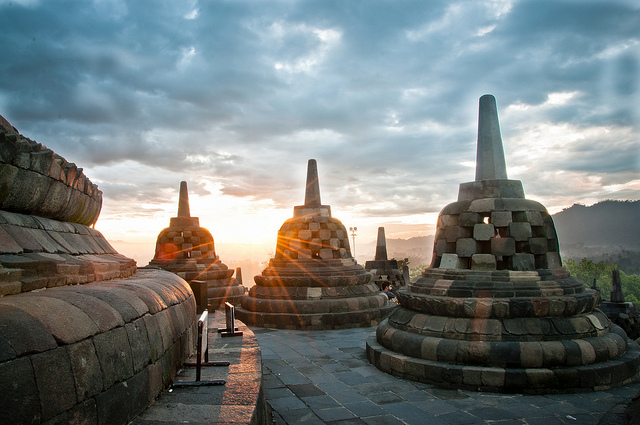
Borobudur is a breathtaking Buddhist temple that has become emblematic of Indonesia and is one of the nation’s most popular tourist attractions with good reason, but you’ve also got towering Prambanan Temple, the impressive Great Mosque of Demak, and the Yogyakarta Palace to amaze and humble.
If colonial history is of interest to you, you’ll find plenty of Dutch influence in the architecture of cities such as Jakarta. Once known as the Dutch East Indies, Indonesia still possesses some of this colonial influence, and it makes for some startling contrasts against the modern architecture that now dominates Indonesia.
It wouldn’t be an Indonesia countdown without including the nation’s most famous island. Bali is so famous that, in all seriousness, I’ve met people who honestly thought it was a country all of its own.
Australia’s most beloved beach playground, the beaches of Kuta have become infamously associated with Bintang singlet wearing, Southern Cross tattoo having bogans looking for a fight. With flights to Bali being very affordable from most Australian cities, it’s no surprise that we Aussies flock there in droves. Many a first-time traveler has graced the hostels in Bali and ‘discovered themselves’ after three too many cocktails.
It’s a real shame too, as there is far more to Bali than just the tourist strip. As Justine from The Travel Lush says, there’s more than just Kuta in Bali.
From the hipster heaven of Ubud to emerging spots like Canggu, there’s something for all walks of life on Indonesia’s most beloved island.
With Richelle and I looking for a base for 2018, you’d best believe we’ve been reading Little Grey Box’s detailed guide to living in Bali.
Indonesia possesses some truly world class scuba diving sites, and diving enthusiasts are sure to find something here that they’ve found nowhere else in the world.
While scuba diving in Pulau Weh earlier this year, I was diving alongside people with so many dives to their name that they’d lost count, but you’d best believe we all emerged from the water with the same looks of wide-eyed wonder on our faces.
20% of the world’s coral reefs can be found in Indonesia, and that is further complemented by ancient wrecks, underwater volcanoes, and a whole swathe of other attractions.
If you do make it to Pulau Weh, be sure to go diving with Rubiah Tirta Dive Center, who took amazing care of me both during my dives and after I broke my arm falling off their boat like an idiot.
For those wanting the prototypical desert island experience, the white sands, turquoise waters, and coconut palms of the Gili Islands might be just what you’re looking for.
While the islands (especially Gili Trawangan aka Gili T) have experienced a huge upswing in popularity in recent years, they’re still considerably less developed and less crowded than the Kuta tourist strip in nearby Bali.
The three islands each boast something a little different: a vibrant backpacker scene on Gili T, a laid-back local vibe on Gili Air, and an upmarket charm on Gili Meno.
Whichever island you choose, you’ll be hard-pressed to find a more gorgeous corner of the world.
For those wanting to get well and truly off the beaten path and experience unspoiled natural beauty, East Java might be the tonic for what ails you.
A lost world of volcanic peaks, jungle valleys, and unspoiled wilderness, East Java is Indonesia’s least populated province and one of its most endearing.
The Bromo-Tengger-Semeru National Park is home to the towering twin volcanic peaks of Mount Bromo and Mount Semeru, and the land surrounding the volcanoes is one of fertile forest, serene crater lakes, and rugged mountains. It’s truly spectacular.
The Ijen Plateau is a volcanically active region that draws adventurers and hikers from all around the world. Ijen Crater, with its brilliant blue waters, is a highlight of the arduous hike into the mountains.
For pure natural beauty, it’s hard to rival East Java’s rugged interior. While many think of Indonesia’s beaches when they plan their trip, it’s worth remembering the nation’s truly stunning mountains as well.
For those wanting to get away from it all, there are few places on earth farther away from ‘it all’ than gorgeous Raja Ampat.
Home to some of the world’s best scuba diving, the four islands of Raja Ampat are located in the Western Papua province – a long way from the more well-touristed areas of Indonesia.
Its location makes it difficult to reach and its lack of tourism development means you’re going to be off the grid while you’re there, but if being away from your emails for a few blissful weeks sounds good to you – there are few places on earth better than Raja Ampat.
You don’t need HBO to see dragons. Indonesia’s Komodo National Park is home to the impressive Komodo Dragons, gigantic members of the monitor family famed for their aggression and their fearsome predatory instincts.
Confined to just two islands in the park, the Komodo Dragons are one of Indonesia’s best-known inhabitants, and the chance to walk alongside these 3+ metre reptiles is a real thrill, even if they’re content to just lie in the sun and wait for somebody to throw scraps from the kitchen window.
While the Komodo Dragons may be the real drawcard for the region, I myself loved the experience of overnighting on a houseboat out among the islands and swimming in the crystal clear waters. After a long, hot day of trekking in search of Komodo Dragons, it’s a real treat to slip into the water and wash away the day’s dust.
Indonesia’s largest island is one of its most breathtakingly beautiful, and you could easily use up the entirety of your 30-day visa exploring just a fraction of Sumatra’s sprawling charm.
My ten-day visit to Indonesia in February only managed to scratch the surface of northern Sumatra, where we were able to trek into the jungle looking for orangutans, scuba dive Pulau Weh, and spend a few blessedly serene days on Lake Toba.
The island’s rugged interior is home to all manner of wildlife, including Sumatran tigers and orangutans. While the endandered tigers are a rare sight indeed, ambitious explorers can embark on week-long (or longer) treks into the jungle in search of them.
Surfers, scuba divers, and beach lovers will find plenty to love on the small islands that lie off Sumatra’s coast, while Lake Toba makes for one of the most relaxing escapes you’re likely to find – it’s all idyllic farms and quiet beaches.
Put simply, Sumatra is reason enough to visit Indonesia even if the rest of this list hasn’t won you over.
As you can see, Indonesia is far more than “just Bali”. Whether you’re a scuba diver, a hiking enthusiast, a wildlife lover, a culture junkie, or an amateur historian, there’s a little something for everyone!
Mix that in with amazing food, cheap prices, and friendly people, and you’ve got a recipe for an unforgettable vacation.
Interested in making it happen? Check out Momondo for the best prices on flights and accommodation.
Your Say
Have your travels taken you to Indonesia yet?
What has been your favourite Indonesian experience?
They come in their thousands to pay homage at altars of flashing neon whose hymns are the jingling of coins and the digital beep-boop of half-mad robots. Pilgrims with wallets full of money and hearts full of ill-placed hope flock from Mainland China to try their hand at tricking Lady Luck out of a few HKD.
It’s certainly a city that does a good job of recreating some of the glitz and glamour of North America’s own den of chance and iniquity, Las Vegas.
Here and there, jutting out of the weather-stained tenements and industrial estates, are dazzling towers at odds with the earthy feel of their surrounds.
They cluster on one side of the island like the end of an evolutionary timeline. Something for their humbler, smaller neighbours to aspire to.
Despite their shining exteriors and their eye-catching architecture, the casinos rarely hold my eye for long. Indeed, it is to the low-lying areas of grime and disarray that my eyes are drawn.
There’s a certain charm in the jumble of tumbledown buildings in various clashing colours all united in the uniformity with which they’ve been weathered.
Many of these one, two, or three story buildings are adorned with shocks of green – tenacious gardens resisting the ever encroaching urban sprawl that spreads across from the mainland like an illness.
I paint a less than flattering picture, but this juxtaposition is far from depressing – it’s fascinating.
The glitter of the modern casinos is emphasised by the dour tenements, just as their antique charm is highlighted by their proximity to these shrines to decadence.
Standing out from these two warring dynasties – commercialism and colonialism – the crumbling ruins of St. Paul’s Cathedral sit in quiet contemplating amidst an island to greenery.
I didn’t know what to expect when I arrived in Macau, but it’s been quick to capture my imagination.
More Than Just Casinos
Macau, sometimes known as the “Vegas of China” gets a bit of a bad wrap from tourists. The glittering casinos make people think that there’s nothing more to Macau than the skin-deep; shallow enjoyments designed to conceal a place without charm.
This assessment couldn’t be farther from the truth, as I found out on my recent two-day visa run to the gambling capital of Asia. Far from being a tacky Vegas knock-off, Macau was bursting with charm and hidden secrets that I was only too happy to explore.
With just one day to see the best that Macau had to offer, I came up with a one day Macau itinerary to ensure I saw it all.
Macau in 24 Hours: A One Day Macau Itinerary
Eat a Macanese breakfast
You’ll want to start your day bright and early. While Macau isn’t a large area to explore, we’re going to be doing quite a bit of walking (and eating), so save your sleep in for tomorrow!
With so much delicious Macanese food you’ll want to try, my advice is to head over to Travessa do Auto Novo and see what is on offer.
I helped myself to a hearty pork chop bun, which is the Macanese equivalent to a hamburger. It’s a filling bite!
Wander the Old Town
I can’t overstate this enough: Macau’s old town is fascinating!
While there aren’t any ‘must see’ landmarks in the labyrinthine alleys of Macau’s old town, you’re living and breathing real local life as you traverse these man-made canyons of colourful buildings, taut power cables, and hidden shrines.
I dedicated an hour or two to just meandering through the hustle and bustle of everyday Macanese life and it was one of the highlights of the day. Watching kids play soccer in narrow alleys while their parents cooked or cleaned or shouted for customers was a real pleasure, and I delighted in finding cute little nooks where Buddhist shrines or Catholic crosses had been hung up for locals to pray at.
Your wandering might feel a bit overwhelming, but all roads lead to civilization – just follow long enough and you’ll eventually come to a sign pointing you in the direction of local landmarks such as Senado Square and St. Paul’s Cathedral.
Tip: If you’re getting peckish while you wander around, look for a little stall or hole in the wall eatery with at least one person in line. Go eat there!
People watch in Senado Square
Senado Square is one of the most popular non-casino destinations in Macau, but the open European-style square doesn’t feel over-crowded as you wander its black and white cobblestones and soak in the ever present sun.
Once the beating heart of colonial Macau, Senado Square is not a mixture of heritage buildings and modern style. Inside these gorgeous old buildings, you’ll find trendy boutiques, Western pharmacy chains, and overpriced eateries looking to capture the eye of hungry tourists.
St. Dominic’s Cathedral
Ducking into the beautiful St. Dominic’s Cathedral is a great way to escape the heat and the crowds, with a polite guard on hand to shush the over-enthusiastic as they wander this classic example of a Baroque church.
Take a few quiet moments to soak in the beautiful interior of the church or (if you’re a lapsed Catholic like me) say a long overdue Hail Mary or three.
Shopping!
If you came to Macau to do some shopping, you can wander the nearby Rua da Tercena to browse the mixture of local market stalls and international brands selling everything from Korean beauty products to American sneakers to high priced liquors.
It’s not really my scene, but I did like wandering the market stalls to hear the haggling between hardened local women and wide-eyed international tourists.
Visit the Ruins of St. Paul
A short walk from Senado Square is Macau’s most recognisable colonial landmark: the ruins of St. Paul’s Cathedral.
Once the largest cathedral in East Asia, St. Paul’s almost feels cursed when you consider that it burned down three times before the Church finally decided to leave well enough alone.
Today, its facade stands as a lonely testament to the fading of colonial Europe’s grip on the East and the growth of both local governance and local religions.
This is likely to be the most crowded place you’ll visit, so I recommend snapping a few pictures and then getting out of here.
Tip: If you want unspoiled photos of the monument, it’s best to come for the sunrise. The crowds don’t disperse until after dark, so morning is likely to be your best bet for a photo without someone in it.
Climb to Old Fort
Right next to the Ruins of St. Paul is Macau Fortress, which sits atop a hill that provides a nice view of the ruins and the city.
The green gardens are alive with mosquitos on a humid day, but it’s a nice spot to take a break if your legs are sore from wandering all morning.
The ruins themselves aren’t especially impressive, but the view out over the city and the bristling cannons do make for a good photo opportunity.
While up here, you’ll want to escape the heat and pay a visit to the Macao Museum. The museum not only has exhibits about Macau’s colonial history, but also its local culture and the city’s evolution in recent years.
Lunch at Albergue 1601
It’s a bit of a walk to our next stop, but you’ll be wandering more of those broad, cobblestone streets with the brightly coloured colonial buildings for company. You’ll also want to work up a bit of an appetite, as our next stop is the delectable Albergue 1601 restaurant!
Offering a mixture of Portuguese and Macanese favourites, this upscale eatery is set in a gorgeous old building and has some wonderfully friendly staff as well.
I ordered the spicy African Chicken for my main and finished with a sweet Serradurra (sawdust pudding), as well as enjoying an ice cold glass of sangria to cool me off after the walk.
Across from the restaurant, there’s also a small art gallery with rotating exhibits you might want to check out. It was an African inspired exhibition while I was there, but who knows what you’ll find?
Take the cable car to the lighthouse
With bellies full, it’s time to wander to our last landmark in the old town – the Guia Fortress and Lighthouse.
The walk is a less inspiring one, as you’ll be wandering along modern streets with the accompanying crowds and traffic, so feel free to grab a taxi or a local bus if you’re feeling like a break.
Another iconic bit of Portuguese heritage, Guia Fortress has a history dating back more than three hundred years. The accompanying chapel and lighthouse (the first of its kind in East Asia) are worth a look as well.
The cable car to the top of the hill is just $1 USD (return), so avoid the uphill and spend some time wandering the gardens and historic sites at the top of the hill. There’s also a stunning view of the city from up here.
Tip: If you come here for sunset or sunrise, you’ll get some splendid shots of the city.
Visit Taipa village and eat all of the things
It should be mid afternoon by now, so let’s bid farewell to the hustle and bustle and make our way to Taipa.
Best known for being where both the airport and the ferry terminal are, Taipa still has plenty of charm in the form of its local neighbourhoods and its own select of casinos.
The main thing we’re here to do is eat, and there is plenty of options when it comes to afternoon tea:
Egg Tarts from Lord Stow’s Bakery;
Pork Chop Buns from Cafe Tai Lei Loi Kei
Seng Cheong for crab congee
Local candies and almond cakes at Koi Kei Bakery
Serradura or durian ice cream at Mok Yi Kei
All of the above are located in the popular Taipa Village area, renowned for its historic buildings and its local colour.
Go casino hopping
Casinos aren’t really my thing, but it would be remiss of me to write a one day Macau itinerary without at least touching on the peninsula’s most popular attraction.
Even if rolling the dice or spinning the roulette wheel aren’t your cup of tea, the casinos in Macau do offer a number of other distractions that don’t involve games of chance.
From The Venetian’s impressive canals to the impressive water show at the City of Dreams to live music and cheap drinks at Sands, there’s a little something for everyone here.
Kids can check out the waterslides at The Parisian or the amusement park at Studio City Macau, while the grown ups might want to catch a show in Macau.
Have you ever been to Macau? What were your highlights from China’s Vegas?
My stay in Macau was made possible by the wonderful people at Sofitel Macau at Ponte 16. I’ll write more about their fantastic hospitality soon, but they were a huge help in helping my plan my one day Macau itinerary.

 By
By